Grounding and the Reliability of AI
Introduction
An ungrounded AI tool has exactly one move: predict the next word from everything it absorbed in training, then the next, and the next. It has no way to consult a fact, check a source, or notice that it does not know - so when it reaches the edge of what it memorized, it does not stop. It fills the gap with something fluent, confident, and frequently wrong. A grounded AI system works differently: before it answers, it retrieves the relevant evidence, acts through real tools where it can, and cites what it used. The gap between the two is not model size or leaderboard rank. It is the difference between an answer anchored to something checkable and one that is not - and, across a decade of peer-reviewed measurement, that gap is large.
- The default fails: asked questions with verifiable answers, ungrounded models fabricate at rates from four-in-ten to nearly nine-in-ten - and state the fabrications with confidence.
- Grounding closes the gap: retrieve the evidence first and the same model’s factual accuracy jumps by tens of points; a small grounded model can beat one fifty times its size.
- Grounding makes results checkable: an answer tied to a cited source can be verified; an answer from memory can only be trusted.
- Grounding is necessary, not sufficient: it sharply reduces fabrication but does not end it, and poor retrieval can make things worse - which is why grounding is engineering, not a prompt.
The tool that can’t check itself
The clearest place to watch an ungrounded model fail is on questions with checkable answers. In a 2024 study in the Journal of Legal Analysis, researchers at Stanford’s RegLab asked leading language models specific, verifiable questions about randomly selected United States federal court cases - the kind of thing a first-year associate could look up. The models answered from memory, and the memory was full of holes. The study found that legal hallucinations are “alarmingly prevalent,” occurring between 58% of the time with ChatGPT 4 and 88% with Llama 2 when the models were asked about real cases they had almost certainly seen in training. Between roughly three-in-five and nine-in-ten answers were invented.
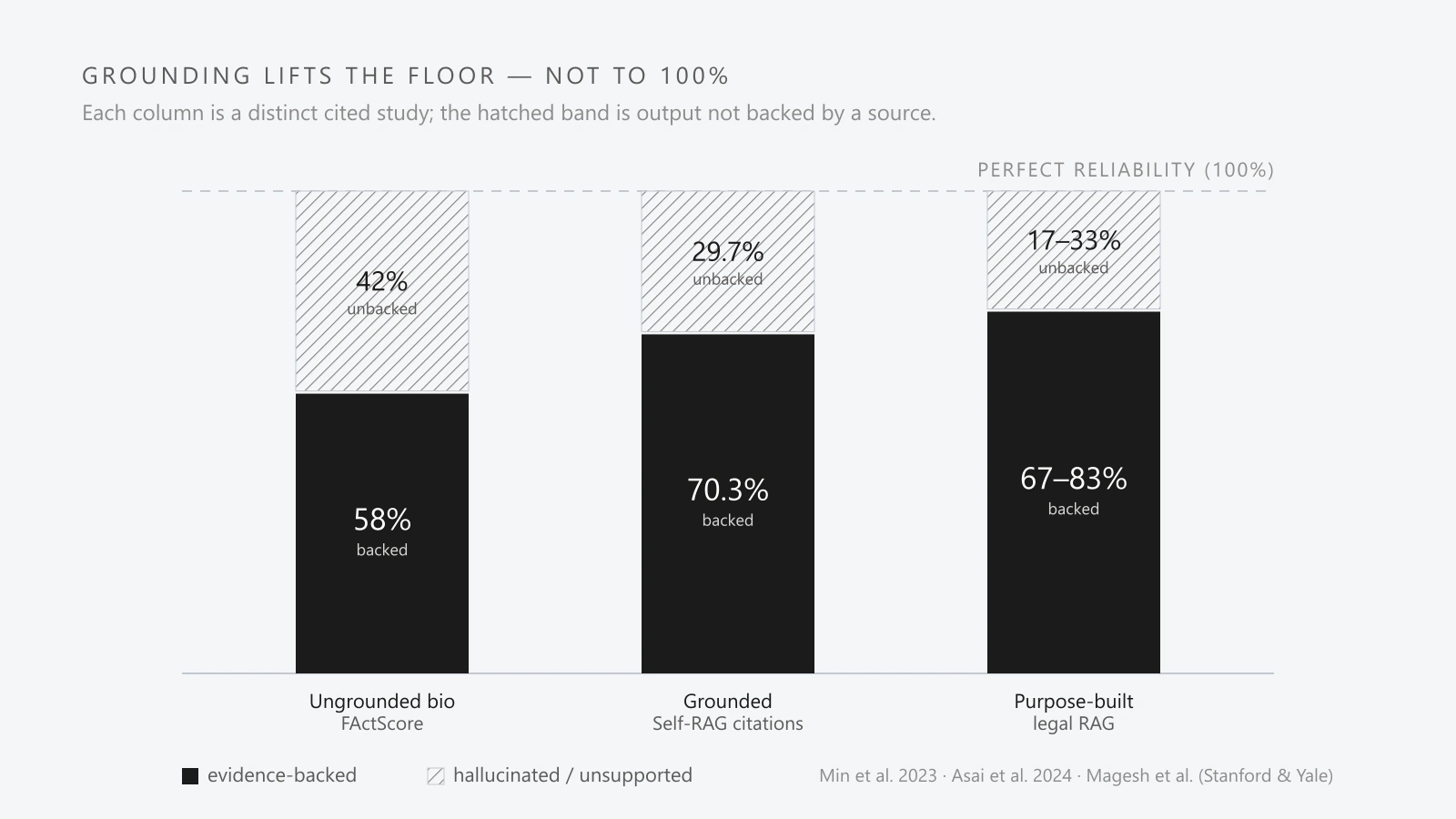
This is not a quirk of law. When a separate team built FActScore - a measure of what fraction of the individual facts in a passage are supported by a reliable source and pointed it at ChatGPT writing biographies of real people, the model scored only 58%. More than four in ten of the atomic facts it stated about actual human beings were unsupported by any source. The generation was fluent, specific, and roughly half fiction.
The dangerous part is not the error rate on its own; it is that the errors arrive dressed as knowledge. OpenAI’s own SimpleQA benchmark, a set of short factual questions, found that models answer almost everything put to them - GPT-4o attempted 98.9% of the questions - and that, plotting confidence against correctness, the models “consistently overstate their confidence.” An ungrounded model has no mechanism to say “I could not find that.” Prediction is its only operation; abstention is not a natural output. So it produces a plausible answer whether or not a true one exists, and from the text a reader cannot tell the two apart. For a marketing chatbot that is a nuisance. For a system asked which invoices are overdue or which technician’s callback rate is climbing, a fabricated number that looks exactly like a real one is the worst possible failure.
What grounding means
The fix is not a smarter model; it is a differently wired one. Grounding is the practice of tying a model’s output to an external, verifiable source rather than to its own memory: retrieving relevant evidence and conditioning the answer on it, calling a tool and reading the result, and, where possible, citing the source so a human can check the work. The formal version of the idea is precise. In a 2023 paper in the MIT Press journal Computational Linguistics, Rashkin and colleagues defined a framework they call Attributable to Identified Sources, which stipulates that a model’s statements about the world are “to be verified against an independent, provided source.” That is the whole distinction in one line: a grounded answer can be checked against a source that is not the model; an ungrounded answer can only be believed.
It is worth being clear about what grounding is not. It is not a bigger context window - pasting an entire dataset into the prompt is not grounding, and long contexts degrade in their own well-documented ways, as we cover in our companion research on the data foundation. It is not a better base model - the point of the evidence below is that grounding lifts a fixed model. And it is not clever prompt wording. Grounding is an architecture: a retrieval step, a tool call, a verification loop - infrastructure sitting between the question and the answer that supplies the model with something true to stand on. The rest of this piece is the measurement of what that architecture buys.
Retrieval closes the gap
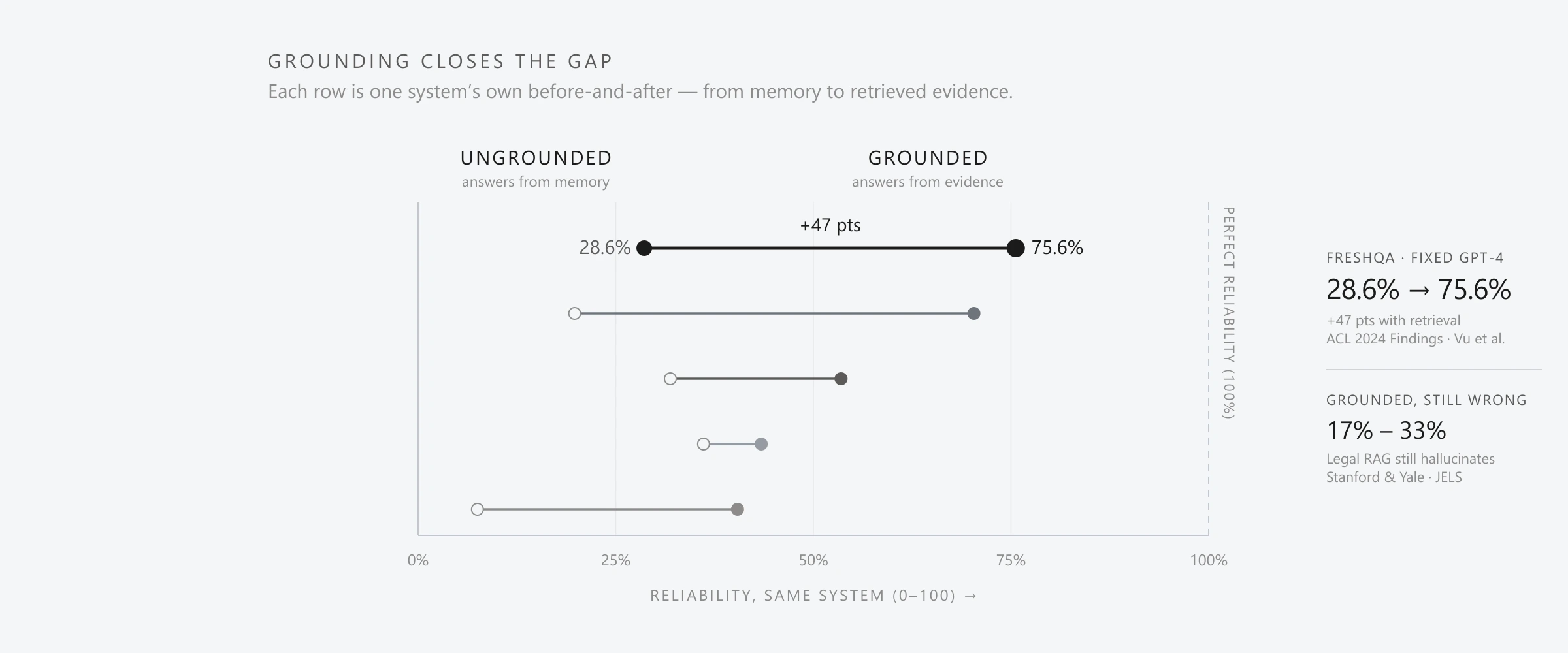
The most direct evidence holds the model fixed and adds retrieval. In a paper at ACL 2024, a team from Google, the University of Massachusetts Amherst, and OpenAI tested GPT-4 on FreshQA, a benchmark of questions whose answers change over time, under a strict metric that counts an answer correct only if it contains no hallucination. Answering from its own parameters, GPT-4 scored 28.6%. The same GPT-4, given the ability to retrieve current evidence from a search engine and condition its answer on it - a method the authors call FreshPrompt - scored 75.6% under that same strict metric. Nothing about the model changed. Grounding it in retrieved evidence raised its no-hallucination accuracy by more than forty-seven points.
The gain is large enough to reorder the usual hierarchy of model size. Meta’s Atlas, a retrieval-augmented model with 11 billion parameters, reached 42.4% on the Natural Questions benchmark from just 64 training examples - outperforming a 540-billion-parameter model by 3% despite having 50x fewer parameters, in the authors’ words. A model one-fiftieth the size beat a giant, because it could look things up instead of memorizing them. And because Atlas lets you compare the same architecture with and without retrieval, it isolates the effect cleanly: on the MMLU exam, the closed-book 11-billion-parameter model scored 36.1%, and the retrieval-augmented version of that same model scored 43.4% - a 7.3-point gain attributable to grounding alone, with the model held constant. Retrieval is not a bigger brain. It is a brain that stops guessing.
Grounding in tools and actions
Retrieval grounds a model in documents; tools ground it in the world. The clearest demonstration is ReAct, a method from Princeton and Google at ICLR 2023 that interleaves a model’s reasoning with actions - searching, looking things up, reading what comes back - so each step is anchored to a real observation rather than to the model’s imagination. In a human study on the HotpotQA task, the researchers traced where each approach went wrong. For pure chain-of-thought reasoning, unmoored from any external source, hallucination was “a serious problem,” accounting for 56% of its failures. For the tool-grounded ReAct agent, hallucination accounted for 0% of failures - it could still be wrong, but it did not make things up - and its false-positive rate was less than half of chain-of-thought’s (6% versus 14%). Grounding did not merely raise the score; it removed an entire failure mode.
And because a grounded agent can act, not only answer, its advantage extends past facts into tasks. The same paper reports that on two interactive benchmarks - a simulated household and an online-shopping environment - ReAct beat specialized imitation- and reinforcement-learning systems by an absolute 34% and 10% in success rate, using only one or two examples. The lesson holds as models shrink. Toolformer, a model from Meta at NeurIPS 2023 taught to call simple tools - a calculator, a search API, a calendar - has 6.7 billion parameters. Grounded that way it beat the 175-billion-parameter GPT-3, a model twenty-five times larger, on factual and mathematical tasks: on the LAMA T-REx fact-completion benchmark it went from 31.9 to 53.5 against GPT-3’s 39.8, and on the ASDiv math benchmark from 7.5 to 40.4 against GPT-3’s 14.0. A small model that can use a tool beats a large one that can only remember.
Results you can check
Accuracy is only half of what grounding buys. The other half is that a grounded answer carries its receipts. Because its claims are tied to identified sources, they can be checked - by a person, or automatically. Researchers at Google built AutoAIS, an automatic measure of whether an answer is actually supported by the source it points to, and found it tracks careful human judgment with a Pearson correlation of 0.96 at the system level. Verifiability, in other words, is not a vague virtue; it is a quantity you can measure and then optimize.
Once you can measure it, you can improve it. RARR, a method at ACL 2023, takes a model’s ungrounded answer, researches it, and edits it to match the evidence - raising attribution by up to 13% absolute while changing only 10-20% of the text, and preserving the original wording more than 90% of the time where earlier methods managed 6 to 40%. Self-RAG, an ICLR 2024 method that teaches a model to decide when to retrieve and to critique its own citations, roughly tripled citation precision on a long-form question-answering task over a conventional retrieval baseline, from 19.8 to 70.3. The through-line is simple: an ungrounded tool asks you to trust it and gives you no way to check; a grounded system hands you the sources and lets you verify. Anywhere being wrong has a cost, that is the difference between a demo and something you can put in front of a customer.
Where grounding still fails
An honest version of this argument has to say where grounding stops, because the failure mode is instructive. Grounding is necessary; it is not sufficient. The sharpest evidence comes from the same Stanford group, now with Yale, testing the purpose-built legal-research tools that vendors marketed as “hallucination-free.” Even these - retrieval- augmented systems grounded in real legal databases - still hallucinated “between 17% and 33% of the time,” and the study concluded the providers’ claims were “overstated.” Grounding cut fabrication sharply from the 58-to- 88% of the ungrounded baseline, but it did not reach zero - and a tool that is wrong a fifth of the time while claiming to be flawless is arguably more dangerous than one that is honestly uncertain.
The mechanism behind the residue matters, because it points at what grounding actually requires. Grounding a model in the wrong evidence is worse than not grounding it at all. When Google researchers added irrelevant sentences to grade-school math problems the models could otherwise solve, accuracy “dramatically decreased” - the model dutifully used the context it was given, even when the context was noise. And grounding can backfire in a subtler way: a 2025 study at ICLR found that supplying retrieved context often makes a model abandon the safe answer of “I don’t know.” Given context, Gemini 1.5 Pro’s abstention rate on unanswerable questions fell from 100% to 18.6%, and across models the authors found that “models hallucinate more than they abstain,” the mere presence of context inflating confidence into a wrong answer where silence was correct. Even with the source document in hand, fabrication does not vanish: on Vectara’s grounded-summarization leaderboard - where the model is told to use only the passage provided - the best systems hallucinate on only about 2% of summaries as of late 2025, but many frontier chat models still exceed 10%, and the weakest approach one in four.
None of this refutes the claim; it sharpens it. Grounding delivers its large, repeatable gains only when the retrieval is good, the sources are governed, and the system is built to abstain when the evidence is thin. That is exactly why grounding is not a switch you flip but an engineering discipline - retrieve the right evidence, govern its quality, cite it, and verify. Which is the whole point: the reliability lives in the system, not in the model.
Build the system, not the tool
Put it together and the shape of the claim is clear, and clearly bounded. Left to answer from memory, models fabricate at rates that make them unusable for anything with a checkable answer, and they do it with unwarranted confidence. Ground the same model in retrieved evidence and its factual accuracy jumps by tens of points; ground it in tools and it stops making things up and starts getting things done; ground it in cited sources and its answers become things you can verify rather than merely believe. The one honest caveat - that grounding fails when the grounding is poor - is not an escape hatch for the ungrounded tool. It is the specification for building the grounded system properly.
| An ungrounded tool | A grounded system | |
|---|---|---|
| Where an answer comes from | Its own training memory | Retrieved evidence, tools, and cited sources |
| When it does not know | Fabricates, confidently | Retrieves, or abstains |
| Can you check it | No - you trust the text | Yes - you follow the citations |
| Wrong-answer failure mode | A fabrication that looks real | A traceable, correctable miss |
| How it gets better | Wait for a bigger model | Better retrieval, governance, verification |
| What breaks it | A question past its memory | Poor retrieval or ungoverned sources |
This is the discipline Ardenus brings to the operators who run the physical economy - the field-service businesses most likely to be handed a chatbot and least equipped to make one safe. Rather than point a bare model at a business and hope, Ardenus grounds it: unifying the operational data a company already generates, governing it, modeling it into an ontology, retrieving the right slice for each question, and acting through governed workflows that carry their own audit trail. The model is one component; the grounding is the product. We make the companion argument - why the data foundation is the part that actually fails - in our research on why AI initiatives fail at scale, and you can see the platform itself on the technology page. Do not buy the tool that answers from memory. Build the system that answers from the truth.
Sources and methodology
- Large Legal Fictions: Profiling Legal Hallucinations in Large Language Models (Dahl, Magesh, Suzgun & Ho, Journal of Legal Analysis / Stanford RegLab, 2024) - the 58%-to-88% hallucination envelope on verifiable federal-case questions.
- FActScore: Fine-grained Atomic Evaluation of Factual Precision in Long Form Text Generation (Min et al., EMNLP 2023) - ChatGPT biographies only 58% of atomic facts supported.
- Measuring short-form factuality (SimpleQA) (Wei et al., OpenAI, 2024) - models attempt almost every question and “consistently overstate their confidence.” Used only for the attempt-rate / overconfidence finding, not as a general accuracy rate.
- Measuring Attribution in Natural Language Generation Models (Rashkin et al., Computational Linguistics, MIT Press, 2023) - the Attributable to Identified Sources (AIS) definition of grounding.
- FreshLLMs: Refreshing Large Language Models with Search Engine Augmentation (Vu et al., ACL 2024 Findings) - a fixed GPT-4 rising 28.6% -> 75.6% under the strict no-hallucination metric with FreshPrompt (+47 points).
- Atlas: Few-shot Learning with Retrieval Augmented Language Models (Izacard et al., JMLR 2023 / Meta FAIR) - the 11B retrieval model beating a 540B closed-book model, and the within-architecture MMLU 36.1% -> 43.4% grounding gain.
- ReAct: Synergizing Reasoning and Acting in Language Models (Yao et al., ICLR 2023) - hallucination in 0% of ReAct failures vs 56% for chain-of-thought, and the +34% / +10% task gains; and Toolformer: Language Models Can Teach Themselves to Use Tools (Schick et al., NeurIPS 2023) - a 6.7B tool-using model beating GPT-3 175B.
- Attributed Question Answering (Bohnet et al., Google Research, 2022) - AutoAIS tracking human attribution at r=0.96; RARR: Researching and Revising What Language Models Say (Gao et al., ACL 2023) - +13% attribution editing only 10-20% of text; and Self-RAG (Asai et al., ICLR 2024) - citation precision 19.8 -> 70.3 over a plain retrieval baseline.
- Hallucination-Free? Assessing the Reliability of Leading AI Legal Research Tools (Magesh et al., Journal of Empirical Legal Studies / Stanford RegLab & Yale, 2024) - purpose-built legal RAG tools still hallucinating 17%-33% of the time, the “hallucination-free” marketing “overstated.”
- Sufficient Context: A New Lens on Retrieval Augmented Generation Systems (Joren et al., ICLR 2025) - RAG collapsing safe abstention into confident errors; and Large Language Models Can Be Easily Distracted by Irrelevant Context (Shi et al., ICML 2023) - irrelevant retrieved context “dramatically” degrading accuracy.
- Vectara HHEM Hallucination Leaderboard (Vectara, grounded-summarization hallucination rates, cited as a dated late-2025 snapshot in ranges because the live leaderboard drifts).