The H-2B Cap Is the Ceiling on Lawn-Care Growth
Introduction
A multi-branch lawn-care operator can have more demand than it can serve and still be unable to grow, because the thing standing between it and the next dollar of revenue is not a customer. It is a crew. In a tight-labor market the binding constraint on output is the number of seasonal crew-hours the company can put in the field, and that supply is capped from the outside: landscaping leans on the H-2B seasonal-worker program more than any other occupation in the country, and Congress caps how many H-2B visas exist. When the constraint is labor and demand is already in surplus, the growth levers change. Adding more demand does nothing you can act on, and adding crews is not, in a capped program, something the operator gets to decide. What is left is getting more revenue out of every crew-hour you already have.
- The constraint is labor, not demand. For a lawn-care operator in a growth market, the season is sold out of crew time before it is sold out of customers. Output is set by how many crew-hours can be staffed, not by how much work is available.
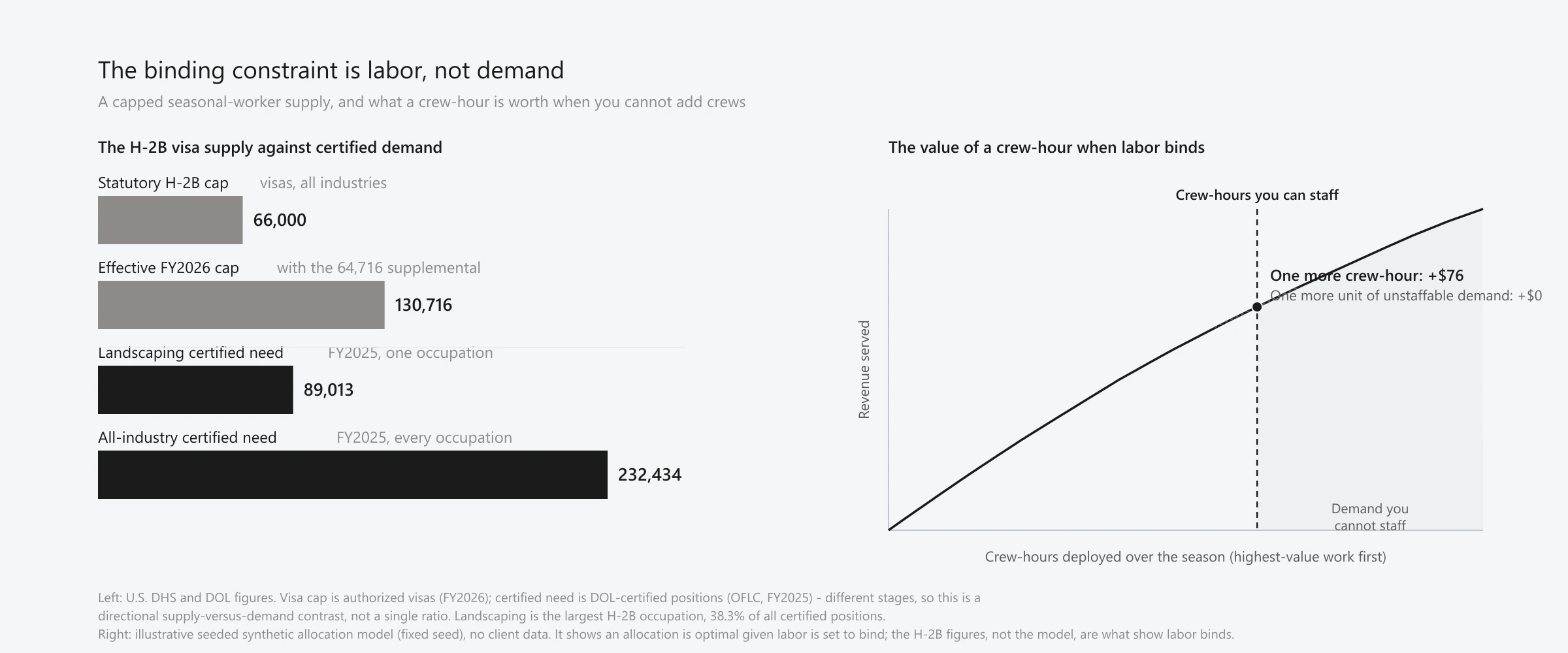
- The crew-hour supply is capped by statute. Landscaping is the single largest H-2B occupation, and the H-2B visa cap is 66,000 a year, raised to about 130,716 for FY2026 by a supplemental that has become an annual fixture. Even the doubled ceiling sits below one industry’s certified demand.
- When labor binds, a crew-hour has a price and demand does not. In a seeded allocation model on this page, the marginal crew-hour is worth about $76, while another unit of the demand you already cannot staff is worth nothing. That gap is the whole argument.
- The lever is revenue per crew-hour. If you cannot add crews, growth has to come from higher-value work, less drive and idle time, and better sequencing, so that each crew-hour books more revenue than it did last season.
Labor or demand: which one binds
Every business is limited by something. The useful question is which limit is active right now, because that is the only lever worth pulling. Economists call the active limit the binding constraint, and there is a clean, old piece of mathematics that tells you what a binding constraint is worth. Frame a season as a plan: an operator wants to maximize revenue by choosing how many crew-hours to put against each kind of work, subject to two kinds of limit, how much work each service line and branch can sell, and how many crew-hours the company can actually staff. Solve that plan and every limit gets a shadow price, the extra revenue you would earn from relaxing it by one unit.
The shadow price is where the argument turns. As the standard treatment in linear-programming dualityputs it, “if a constraint… is not binding, then its corresponding shadow price must be zero,” while a scarce-resource limit “has a positive shadow price, since the expansion of that resource generates additional profits.” Demand, in the same text, is an “external requirement.” So the question “is it labor or demand” has a precise answer: whichever one is binding carries a positive shadow price, and the other carries zero. The claim of this essay is that in today’s lawn-care market it is the crew-hour limit that binds and the demand limit that is slack. That is not a law of nature. It is a claim about this market, and a demand contraction would flip it, making demand the binding side and labor slack. The evidence that labor binds now is the state of the H-2B program, which is the next two sections.
The cap that sets the ceiling
The supply of seasonal workers is not a market quantity that clears at a price. It is a number chosen by Congress. The H-2B statutory cap is 66,000 visas per fiscal year, split evenly into 33,000 for the first half and 33,000 for the second. That base has not been enough for years, so the government keeps topping it up: for FY2026, the Department of Homeland Security and the Department of Labor issued a supplemental rule adding up to 64,716 more visas, which brings the effective ceiling to about 130,716. The same maximum supplemental, 64,716, was issued the year beforefor FY2025, so the top-up is not an emergency measure any more; it is a recurring fixture, and its size is the government’s own admission of how far the base cap falls short.
Two facts make the ceiling real rather than theoretical. The supplemental visas are available only to businesses that attest they will suffer, in the rule’s language, impending irreparable harm without the workers, which is a high bar to clear on purpose. And demand for the visas outruns the supply so reliably that the caps are exhausted almost as soon as they open: USCIS records the first-half FY2027 cap as reached on 4 September 2026, before that half of the fiscal year had even begun. A program whose doubled ceiling is claimed the moment it opens is not a program with slack. It is a hard, non-elastic supply, and it is the ceiling on how many crews a labor-dependent operator can field.
The industry on the cap
None of this would matter to a lawn-care operator if landscaping were a minor user of the program. It is the opposite. In the Labor Department’s certification statistics for FY2025, landscaping and groundskeeping was the single largest H-2B occupation by a wide margin: 89,013 certified positions, or 38.3 percent of all 232,434 positions certified across every industry. The second-largest occupation was under 7 percent. One line of work, in other words, accounts for well over a third of the entire program, and that share held the year before at 37.0 percent. This is a structural dependence, not a one-season spike.
Hold the two numbers next to each other and the squeeze is plain. Landscaping alone had 89,013 positions certified in FY2025, which is more than two-thirds of the entire doubled visa ceiling of 130,716 that has to cover every industry in the country. Across all industries, the 232,434 certified positions are nearly double that ceiling. A word on what these numbers are: a certified position is a finding by the Labor Department that an employer has a real, seasonal job it could not fill domestically; it is a stage in the process, not the same as a visa issued or a worker who arrived. So the comparison here is directional, a measure of certified need set against a visa ceiling, not a single clean ratio. But the direction is not in doubt. The demand for these workers, screened and certified by the government itself, is far larger than the number of workers the government will let in.
Not cheaper labor, no labor
It is tempting to read a guest-worker program as a search for cheaper labor. For H-2B that reading is wrong, and the rules are explicit about it. An employer using the program must first pass a labor-market test: it has to recruit domestically and certify that there are not enough U.S. workers who are able, willing, qualified, and available to do the work. And it must pay the H-2B worker at least the prevailing wage for the occupation and area, the higher of the federal, state, local, or surveyed rate, so the program cannot be used to undercut domestic pay. The constraint the program reveals, then, is not that domestic labor is expensive. It is that at the going wage the labor is not there. Every certified landscaping position is a small government-stamped statement of the same fact: this seasonal work exists, and no available domestic worker took it. That is what a binding labor constraint looks like from the inside.
What a crew-hour is worth
Put the constraint into the season plan and the consequences fall out. The chart on the right of this page is a self-contained, seeded synthetic allocation model computed on public parameters, with no client data anywhere. It gives an illustrative operator a set of work types, each with its own revenue per crew-hour and its own seasonal demand, and a crew-hour budget set below total demand so that labor is the thing in short supply. The operator does the sensible thing: it fills the highest-value work first and stops when the crew-hours run out. In this model that serves about 62 percent of the demand and leaves the rest unstaffed.
The revealing number is the shadow price. Because crew-hours are the binding limit, the model prices the marginal crew-hour at about $76: one more hour of crew time, spent on the best remaining work, is worth about $76 of revenue, and the model’s dual certificate confirms this is the exact, optimal value, not an estimate. The demand limit, meanwhile, is priced at zero. Handing the operator one more unit of the ordinary work it already cannot staff changes its revenue by nothing, because it would simply join the queue of work that goes unserved. A crew-hour is worth $76 and another unit of demand is worth nothing: that is the difference between the constraint that binds and the one that does not, in dollars. Be exact about what the model is and is not. It proves that a particular allocation is optimal given that labor is set to bind; it does not, and cannot, prove that labor binds in the real market. The H-2B figures above do that work. The model just shows what follows once they do.
Growing without more crews
If crew-hours are capped and each one is worth a positive amount at the margin, the arithmetic of growth changes. You cannot grow by adding demand you cannot staff, and you cannot, in a capped program, simply add crews. What remains is to make each crew-hour you already have book more revenue than it did before. This is the oldest advice in the theory of constraints: the output of the whole system is governed by its constraint, so the first discipline is to exploit the constraint, wring the most from the scarce resource, before you try to elevate it by adding more. In this business that means pointing scarce crew-hours at the highest-value work, cutting the drive time and idle time between jobs so fewer crew-hours are spent not-serving, and sequencing the season so a crew is rarely early to one branch and late to another.
None of that is a slogan. It is the definition of productivity made concrete. TheBureau of Labor Statisticsdefines labor productivity as output measured against the labor hours used to produce it, and productivity growth as producing “increasingly more output for the same amount of work.” When the number of crew-hours is fixed from the outside, revenue per crew-hour is the only term in that ratio you can still move. Growth stops being a question of selling more and becomes a question of doing more with the crew time the cap allows.
What this means for the operator
The practical test for a multi-branch operator is quick. Look at last season and ask what actually ran out first: the customers who wanted service, or the crew time to serve them. If the answer is crew time, the company is labor-constrained, and the plans that assume demand is the problem, more marketing, more territory, more sales, are pushing on a limit that is not binding. The lever that is binding is revenue per crew-hour, and the questions worth asking are about the neighboring research: whether the season’s work is even scheduled for the week the window actually opens, what the drive to each job is costing in route cost and windshield time, what a single job actually costs to serve, and how durable, well-run seasonal capacity shows up in what the company is worth.
A disclosure belongs here, plainly. Ardenus sells the intelligence and action layer, the routing, scheduling, and crew-hour allocation, that this essay says is the lever, which makes the argument seller-convenient; a reader should weigh it knowing that. And the honest boundary is narrow. Software does not create labor and does not lift the H-2B cap. The most it can do is help an operator get more revenue per crew-hour it already has, which is exploiting the constraint, not removing it. No result, saving, or forecast is attributed to Ardenus here; the argument rests on public government data and a piece of textbook mathematics, and no client or first-party data appears anywhere in this essay. You can read more of our research on the Ardenus articles hub, or see the platform itself on the technology page.
Sources and methodology
This essay was researched with a multi-agent sweep across primary sources, followed by an adversarial fact-check of every figure and citation. The public figures are U.S. government data, verified firsthand: the 66,000 statutory H-2B cap and the 4 September 2026 first-half FY2027 cap-reached date from USCIS; the 89,013 landscaping certified positions and 38.3 percent share of 232,434 certified positions from the Labor Department’s FY2025 Selected Statistics (37.0 percent the prior year); and the 64,716 supplemental visas, for an effective FY2026 ceiling near 130,716, from the DHS and Labor Department temporary final rule of 3 February 2026, matching the same maximum supplemental issued for FY2025. Certified positions are a labor-certification stage, not visas issued, so the supply-versus-demand comparison is directional rather than a single ratio. The load-bearing quantitative figure is a self-contained, seeded synthetic allocation model computed on public parameters, with no client data: revenue per crew-hour drawn in a $55 to $125 band, seasonal demand in a 200 to 1,100 crew-hour band, and a crew-hour budget set below total demand so labor binds. Filling the highest-value work first serves about 62 percent of demand and prices the marginal crew-hour at about $76, an exact optimum confirmed by the model’s dual certificate; a unit of unstaffable demand is priced at zero. Every one of those numbers is reproduced and node:assert-locked by the committed build script from a fixed seed, and each is an analytical implication of the stated model, not a measurement of any operator. The model shows an allocation is optimal given labor is set to bind; the H-2B figures, not the model, are what show labor binds. The mechanism is grounded in linear-programming duality (a non-binding constraint has a zero shadow price) and the theory of constraints (exploit the constraint before elevating it). No client or first-party data is used, and no result, saving, or forecast is attributed to Ardenus.
- Cap Count for H-2B Nonimmigrants (U.S. Citizenship and Immigration Services) - the statutory 66,000 annual visa cap (33,000 + 33,000 semiannual) and the FY2027 first-half cap reached 4 September 2026.
- H-2B Temporary Non-Agricultural Program - Selected Statistics, FY2025 (U.S. Department of Labor, Office of Foreign Labor Certification) - landscaping certified 89,013 positions, 38.3 percent of 232,434 certified, the single largest occupation.
- H-2B Temporary Non-Agricultural Program - Selected Statistics, FY2024 (U.S. Department of Labor, Office of Foreign Labor Certification) - landscaping certified 90,121 positions, 37.0 percent of 243,798 certified, the prior-year consistency check.
- Increase in the FY2026 H-2B Numerical Limitation (DHS and DOL temporary final rule, 3 February 2026, 91 FR 5040) - up to 64,716 supplemental visas, an effective ceiling near 130,716.
- Increase in the FY2025 H-2B Numerical Limitation (DHS and DOL temporary final rule, 2 December 2024, 89 FR 95626) - the same maximum 64,716 supplemental the prior year, so the shortfall is recurring.
- H-2B Program Requirements (U.S. Department of Labor, Employment and Training Administration) - the labor-market test: the employer must certify that not enough U.S. workers are able, willing, qualified, and available.
- H-2B Temporary Non-Agricultural Visa Program (U.S. Department of Labor, Wage and Hour Division) - the prevailing-wage requirement, so guest labor is not cheaper labor.
- Applied Mathematical Programming, chapter 4: Duality (Stephen Bradley, Arnoldo Hax & Thomas Magnanti, Addison-Wesley; MIT 15.053) - a non-binding constraint has a zero shadow price, a scarce resource a positive one.
- The Goal: A Process of Ongoing Improvement (Eliyahu M. Goldratt & Jeff Cox, North River Press) - the theory of constraints: exploit the constraint before elevating it.
- Labor Productivity and Costs: Questions and Answers (U.S. Bureau of Labor Statistics) - labor productivity is output per labor hour, so a capped crew-hour count makes revenue per crew-hour the lever.